Clinton, from Topp Shelf Building, has worked for us for a number of years. He was reliable and practical from start to finish, communicated well throughout, and his work speaks for itself. Happy to recommend him to anyone.
AboutUs
Owner-operated, Kāpiti-based
Clinton's story, and how the business works — a builder who works the job out before he builds it, and stays accountable for how it turns out.
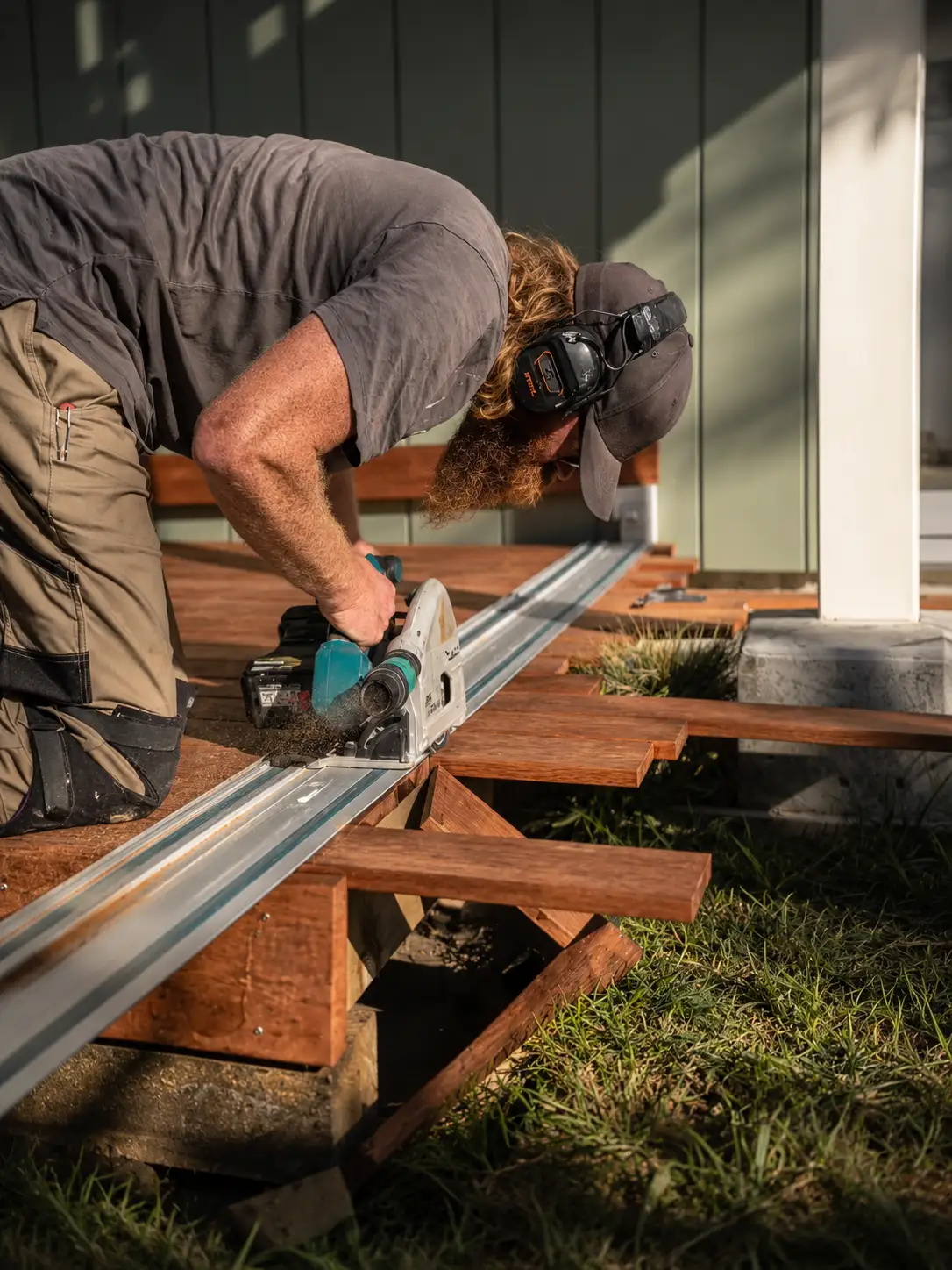
The builder
Clinton's Story
Twenty-plus years in the trade, most of them spent building for someone else — and the deliberate decision to stop, and build for the people who would actually live in the result.
Clinton has spent 20-plus years in the building trade, and most of that time was spent building for developers and larger building companies. It's work that shows you the industry from the inside — how jobs get priced, how sites get run, and how much distance can open up between the builder doing the work and the people who'll live with the result.
Moving to client-direct work was a deliberate decision — in Clinton's own words, a drastic change, not a drift. After years of building other people's projects, he wanted to build for the people who'd actually use them: homeowners and farmers on the Kāpiti Coast, dealing with him directly.
That experience is why we work the way we do. When the person you deal with is the person responsible for the work on site, nothing gets lost between quoting a job and building it. We've kept the team small and hands-on for the same reason — Clinton on the tools and running the job, his son alongside him as apprentice, and subcontractors brought in project by project.
Some of that judgement was bought the expensive way. Clinton designed his own family home with an architect and built it himself, stepping six bedrooms down a Churton Park hillside, then lived in it for about three years — which is the part most builders never get. Living inside your own decisions is how you find out which ones were right, which you would make differently, and what only shows up after a couple of winters. That is the experience behind the questions he asks before a job starts, and the house is on the projects page.
Have a question?
Book a callbackwith Clinton.
Talk to the builder who will run the job — not a salesperson, and not a call centre. Fifteen minutes is usually enough to tell you whether we are the right fit.
Book a callbackAbout our team
A Father-and-Son
Business
Toppshelf Building is run by Clinton and his son, working side by side on every project.
It’s more than just family — it’s a shared work ethic, built on respect, trust and taking pride in the detail.
When you work with us, you deal with the people doing the work.

- Built on
values - Hands-on
approach - Treating your home
like our own
Feedback From Our Locals
What clients say
Testimonial 1 of 7. “Clinton, from Topp Shelf Building, has worked for us for a number of years. He was reliable and practical from start to finish, communicated well throughout, and his work speaks for itself. Happy to recommend him to anyone.” — Mike Russell, Churton Park, Wellington.
Drag to explore
- Years owner-operated
- 13
- Years on the tools
- 20+
- Point of contact
- 1
FAQ
Questions
Before you enquire
Answers to the most common questions we get before a project begins. The full set — pricing, timelines, changes, consent and more — lives on the common questions page.
It depends on the scope of the work and the site — some work needs consent, some is exempt, and the thresholds change, so we'd rather look at your actual job than hand you a generic rule.
Where consent is needed, we handle the application and the council process as part of the job, while being straight about one thing: the consent legally belongs to the property owner, and the council's clock — 20 working days on a complete application — is the council's. We'll tell you honestly at the start what your project is likely to involve.
Duration depends on scope and, where it applies, consent — councils have a statutory 20-working-day clock on complete applications, and a request for more information stops that clock. We give a real timeframe when we quote, not a generalisation here.
On staying with it: we run one main project at a time. Once your job starts, it is the job — you see consistent progress, not weeks of empty site while the builder is somewhere else. Rachel, who named timeframes as her worry before her own project, describes being kept informed throughout and the process as transparent and upfront.
Topp Shelf is run by the builder who owns it: Clinton prices the job and builds it.
When a trade is on site — plumbing, electrical — Clinton remains the one responsible to you. You deal with the builder who carries the job from the first conversation to the last day on site.
We're a Kāpiti-based building company working across Horowhenua, the Kāpiti Coast, Porirua, the Hutt Valley and Wellington City.
How far we'll travel depends on the job — rural builds travel further than small repairs — and the callback settles it in one conversation.
How working with us goes
Clear fromthe start.
We keep it simple so you can move forward with confidence. Here's what happens next.
Make your booking
Pick a time that suits you and we'll talk the project through. You don't have to guess whether we're on the tools — the time is already set aside for you.
Submit any photos or documents
Once you've booked, send through photos, plans or anything else that explains the job. It reaches us before the call, so we're not starting cold — Clinton can look for the parts that will need thinking about before you talk.
A quote, or a discussion of next steps
When we understand the work, you get a quote. Where there's more to work out first — and there usually is something — you get a straight conversation about what that involves.